
VIP System
High Rakeback
Zero-edge originals
Mines guide · zero edge · provably fair
Game mechanics, RTP range, and volatility.
Zero edge selection
Maximize your winning potential by choosing games with 100% RTP


Test without risk
The Mines demo slot is the best way to get a feel for the game and understand betting strategy.
Origins · mechanics · variants
From classic Mines to modern Original Games with 100% RTP
Mines is not a traditional slot in the usual sense, where the player simply hits spin and waits for a combination to land. It is a distinct gambling format built around choice, risk, and knowing when to stop. There are no classic reels, paylines, or old-school bonus rounds - instead, the player faces a grid of hidden tiles, and every next reveal becomes a small test of nerve.
The whole appeal of Mines comes from a simple but nearly perfect conflict: you have already won something, but you could win more. Open one more tile and increase the multiplier - or cash out right now while luck is still on your side? That sense of control, mixed with the fear of losing what you have already built up, is what makes the game so compelling. Mechanically, Mines is closer to an instant win format than a standard slot, with a strong cash-out psychology at its core.
The modern casino version of Mines did not appear out of nowhere. Its roots go back to the classic Minesweeper - the same game that countless people remember from Windows. It was Minesweeper that cemented the core idea in the public imagination: a field of safe tiles hiding unseen danger, where every new click is both tempting and intimidating.
But in iGaming, this mechanic was not simply copied - it was redesigned for gambling. The slow, logic-based puzzle was stripped away, leaving only what mattered most: the tension of choice, instant outcomes, and a clear price for risk. That is how the Mines format known in casinos today came to life: quick to start, flexible in the number of mines, with the multiplier rising after each successful reveal and the option to lock in your result at any moment.
That is exactly where the game's strength lies. It takes barely a minute to understand, but it can keep players engaged for hours. The rule is simple: reveal a safe tile - your potential win gets bigger; hit a mine - the round is over. Yet beneath that simplicity sits the real hook: the constant internal clash between greed, caution, and the hope that "just one more click will be safe."
Over time, Mines grew from a recognizable idea into a full category within gambling. It was adopted by both classic instant win providers and crypto casinos with their Originals, as well as platforms promoting zero-edge or 100% RTP configurations. As a result, one simple format evolved from old computer-game logic into one of the most engaging game styles in modern iGaming.
Today, Mines is no longer just one specific game - it is a whole family of formats. Under the same name, you can find classic 5×5 grid versions, more arcade-style interpretations with bonus features, and row-based variations where the player does not simply reveal individual tiles but progresses upward through rows, gradually increasing the potential payout.
Some versions focus on clean math and freedom of setup: you choose the number of mines, control the pace, and decide for yourself when to stop. Others turn Mines into a more visual, entertainment-driven experience with extra symbols, special multipliers, and a distinct art style. And others move even further into original casino-format territory, where not just the mechanic matters, but also the RTP configuration, max win limits, and the operator's overall philosophy.
The modern snapshot of the genre is especially interesting. On one side, there are recognizable classics like Spribe Mines - easy to understand, fast, and almost canonical within instant win gaming. On the other, there are titles like Mines+ from Pragmatic Play, which add more scale and variety to the genre. At the same time, crypto platforms continue building their own branch through Originals, where Mines is already seen as part of a new culture of fast, risk-driven games.
That is why players today have plenty of choice. Some want the purest possible mechanic, some are chasing higher RTP, some want extreme multipliers, while others care more about atmosphere and pace. Formally, it is still Mines, but in practice different versions can feel very different. And that is one of the reasons the genre has remained popular for so long: it is simple enough for anyone to understand, yet flexible enough to keep evolving.
Game psychology
Why a mine-themed slot became so popular with players
The secret of Mines is not just in the rules, and not just in the RTP percentages. The game taps into something deeper - the place where азарт comes from waiting for the next decision. The player constantly feels that a bigger win is just around the corner: one more safe tile, one more step, one more act of courage, and the current payout will grow meaningfully.
But that is exactly when the real power of Mines kicks in: the fear of losing what you could still walk away with. Every round becomes a delicate battle between the urge to continue and the instinct to stop. One part of the mind says "take it now", while the other pushes you to risk one more click. And while those two impulses compete, the player stays locked inside the tension that Mines sustains almost perfectly.
In that sense, Mines works almost like pure emotion packaged into a simple mechanic. There are no long build-ups, no unnecessary waiting, and no complicated rules to study for hours. There is only you, a field of hidden tiles, and that brief moment before the click when it feels like luck should finally choose your side. That feeling is exactly why players love the game.
Below is a clear comparison table of popular Mines games, from classic formats to zero-edge originals and modern studio interpretations.
| Name | Provider / operator | Grid size | RTP | Max multiplier |
|---|---|---|---|---|
| Mines | Spribe | 5×5 | 97% | x1,000 |
| Mines | Duel Originals | 5×5 | 100% | Not publicly disclosed |
| Mines | Gamdom Originals | 5×5 | 100% | not disclosed as a multiplier max win up to $5,000,000 |
| Mines Zero | MetaWin Originals | 5×5 | 100% | not disclosed as a multiplier max win up to $25,000 |
| Mines+ | Pragmatic Play | 5×5 | 97.50% | Not publicly disclosed |
| Minesweeper | BGaming | 2×3 to 6×15 | 97.88%-98.4% | x15.11 |
| Mine Gems | BGaming | 5×12 | 98.4% | x14.28 |
| Minesweeper XY | BGaming | from 3×2 to 15×6 | 98.4% | Not publicly disclosed |
| Turbo Mines | Galaxsys | 5×5 | 93%-98.89% | x72,000,000 |
| Mines Gold | TaDa Gaming | Not publicly disclosed | Not publicly disclosed | x10,000 |
Math & zero edge
How Duel, Gamdom, and MetaWin removed the casino edge from their original games.
Mines is a game of probabilities, not intuitive "patterns." Every safe tile you reveal increases the multiplier not because the game "rewards bravery," but because the chance of successfully continuing the round becomes smaller. The fewer safe outcomes remain relative to the number of mines, the more expensive the next click becomes.
In a standard casino configuration, the multiplier table is usually set slightly below the ideal mathematical model. That gap is what creates the house edge: over the long run, the average player return stays below 100%, and part of the round's expected value remains with the operator.
In a 100% RTP version, the multiplier curve is configured differently. Over a large sample size, the mathematical expectation is brought back in line with the stake, without extra built-in margin. That does not make outcomes predictable, and it does not remove randomness. A player can still lose several bets in a row just as quickly as they can hit a lucky streak. What changes is not the nature of risk, but who keeps the mathematical edge over time.
That is why 100% RTP should never be confused with a "guaranteed win." It is not a promise of a profitable session and not a button that turns gambling into a source of income. It is simply a fairer payout setup, where the operator does not keep its margin inside the multiplier formula itself.
The beauty of zero-edge mode is that it leaves the player alone with pure probability. No magic, no hidden bonus - just the true price of risk built into the odds of the next move.
Important about zero edge
100% RTP is not a guarantee of winning
Explore other original formats where operators offer zero-edge or max-RTP configurations.





Gameplay & discipline
Mines is almost perfect for players who enjoy fast-paced but disciplined decision-making
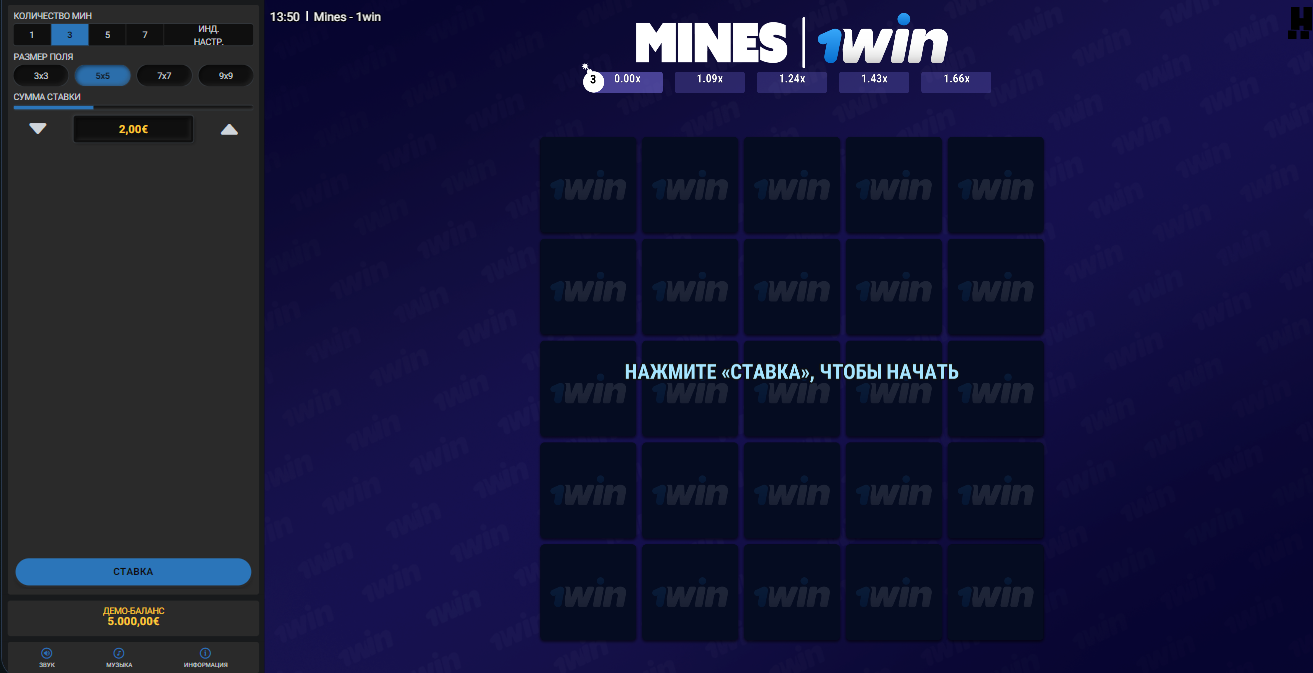
Mines is a game where every decision directly affects the risk of the next move. You choose your bet, set the number of mines on the grid, and start opening tiles one by one. If you reveal a safe tile, the multiplier increases. If there is a mine underneath, the round ends immediately. The defining feature of Mines is that the game constantly puts you in front of the same decision: lock in your current result or take another risk for a bigger multiplier.
Start by setting your stake for the round. For your first few sessions, a smaller bet size is usually best so you can get comfortable with the pace of the game.
The more mines on the grid, the higher the potential multiplier - but each additional click becomes much more dangerous.
Every safe tile increases your multiplier. After a successful reveal, you can either keep pushing the round or stop there.
The most important part is knowing when to stop. Cash out lets you collect your current result before you hit a mine.
Do not try to squeeze out "just a little more" on emotion. It is much better to decide in advance how many tiles you want to open and at what multiplier you plan to exit.
Below is the real logic of a classic 5×5 Mines setup with 99% RTP. The fewer mines on the grid, the softer the risk profile and the lower the maximum multiplier. The more mines a player chooses, the more aggressive the volatility becomes, and the chance of clearing all safe tiles drops sharply.
Your first Mines sessions should be about learning the game and understanding its pace. Define your risk profile and pay attention to how you react to streaks of wins and losses.
A smaller number of mines makes the game slower, but it is better for testing your discipline and using early cash-outs without sharp swings.
Do not jump straight into high-mine setups. It is better to raise the risk step by step, once you understand the multiplier logic and the psychological cost of every extra click.
It is better to enter each round with a clear plan: how many safe tiles you want to open and at what multiplier you will lock in profit.
Demo mode and multiplier tables are useful not only for beginners - they help you understand how quickly the price of the next decision changes with different mine counts.
The biggest mistake in Mines is trying to "win it back" right after a losing streak. The game does not remember previous rounds, and tilt almost always destroys a bankroll faster than the math does.
Psychology of the game
Not just because of the RTP numbers. Mines works on the level of emotion, pace, and the feeling of control.
The rules take less than a minute to understand. The player does not need to study long paytables or wait for bonus cycles - they go straight into the core of the risk.
There are no empty actions in Mines. Even one extra move can turn a careful round into an instant loss - or into a beautifully timed cash-out.
The game leaves the key decision to the player: stop now or keep going. That is exactly what makes even a short session feel emotionally intense.

Answers that matter
The most common questions about the rules, RTP, mine configurations, and how to choose the right version of Mines.
Mines is an instant win game where you open tiles on a grid while trying to avoid hidden mines. Every safe tile increases the multiplier, and after any successful move, you can cash out and collect your winnings.
RTP in Mines varies depending on the provider, the operator, and the specific game math. In classic instant win versions, it is usually below 100%, while in zero-edge or special originals it can reach 100%. In practice, the market includes both standard configurations with lower RTP and selected Mines versions where the operator publicly advertises a max-RTP or zero-edge mode.
100% RTP is not achieved through "special luck" - it comes from configuring the multiplier table without a built-in casino margin. In other words, the long-term mathematical expectation is not reduced by house edge inside the payout formula. Randomness, variance, and the risk of losing an individual session still remain exactly where they are - only the payout distribution model changes.
If you are specifically looking for Mines with a stated 100% RTP, the first place to look is casino originals and zero-edge configurations. This site separately covers options such as Duel Originals, Gamdom Mines, and MetaWin Zero House Edge Originals. But before you play, it is still important to check the current rules, limits, and terms directly with the operator.
The best strategy in Mines is not trying to "guess the right tile" - it is discipline. A sensible approach usually includes a small starting bankroll, a moderate number of mines, a pre-selected cash-out target, and avoiding chase betting after a losing streak. Strategy helps you control risk and pace, but it does not remove the randomness of each round.
In classic 5×5 Mines, the highest maximum multiplier is reached when you choose 12-13 mines on the grid.
Because different providers and operators configure multiplier tables, available mine setups, win limits, and the house edge itself in different ways. Some versions stick to a standard casino model, others focus on provably fair originals, and others promote zero-edge modes. Formally, they are all Mines, but the underlying math can differ a lot.
If you want the simplest and most familiar format, most players start with classic versions like 5×5 Mines. If long-term mathematical fairness matters more, it makes sense to look at options with a stated 100% RTP. And if you care more about gameplay variety, then studio versions, originals, and hybrid formats are worth comparing by grid size, RTP, limits, and maximum multiplier. The best choice depends less on the brand name and more on the risk profile and play style that actually suit you.